
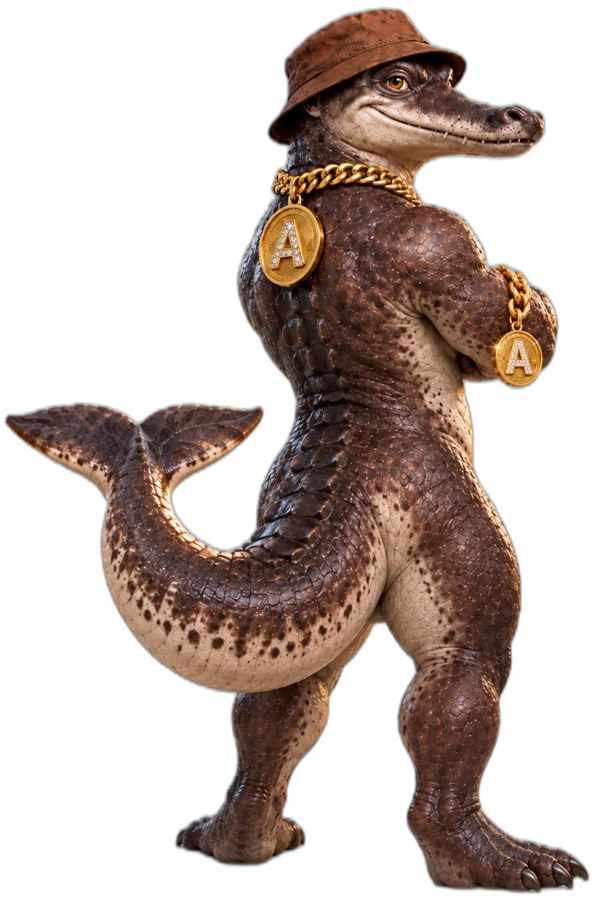
AMBULLO in profile, walking — the pose of his ancestor
Real history

Ambulocetus: the whale that walked.

Ambulocetus natans — literally “the walking whale that swims” — is one of the most famous transitional fossils ever found and the real animal behind the AMBULLO (Ambullocetus) coin. A three-metre predator with four working legs that lived at the edge of the sea roughly 50 million years ago, and whose descendants became the largest animals on Earth.

Name means
“Walking whale that swims”
Latin ambulare (to walk) + cetus (whale); natans = swimming.
Lived
Roughly 50 million years ago
Early–Middle Eocene. Dinosaurs had been gone for about 15 million years.
Found in
Pakistan, 1992
Kuldana Formation. Described in Science in 1994 by J.G.M. Thewissen and colleagues.
Size
~3 m · ~200 kg
Roughly the length of a sea lion, built like a crocodile.
What the fossils say

An ambush predator with legs, on its way to becoming a whale

Ambulocetus had a long, powerful skull with crocodile-like jaws, eyes set high on the head, and strong hind legs with large paddle-like feet. Its limb bones could still bear weight on land, but its spine and hips show an animal that swam by undulating its body and kicking its hind feet — the same up-and-down motion that modern whales make with their flukes.

Its ears were already adapting to hear underwater: the lower jaw carried a bony channel that transmitted sound to the ear the way it does in living whales. Chemical signatures in its teeth show it moved between fresh and salt water — a river-mouth animal that lived at the exact frontier where mammals were leaving the land.

Most likely it hunted like a crocodile: lying still in shallow water, then lunging at whatever came to drink. Nostrils were still at the tip of the snout — the blowhole would take millions more years to migrate to the top of the head.

Why it matters

When Darwin proposed that whales descended from land mammals, critics called it absurd — there was no fossil in between. Ambulocetus is that fossil. It is shown in nearly every biology textbook as the proof that a four-legged animal can, step by step, become a whale.

Land → Ocean → Whale

50 million years of not looking back

~52 MYA
Pakicetus
A wolf-sized land mammal with hooves and a whale's inner ear. Waded in rivers. Still walked everywhere.
~50 MYA
Ambulocetus
The walking whale. Four legs, swims with its feet, hunts like a crocodile at the river mouth. This is him.
~47 MYA
Rodhocetus
Shorter legs, longer tail, nostrils moving back. Mostly in the water now; could still haul out.
~40 MYA
Basilosaurus
Fully marine, up to 18 m long. Tiny vestigial hind legs no longer touch the ground.
Today
Modern whales
Blue whale: 30 m, 150 tonnes. The largest animal that has ever lived. Legs are temporary.

Was it a whale or a land animal?

Both. It is classified within the whale lineage (Cetacea, family Ambulocetidae) but kept fully functional legs. That is exactly what makes it a transitional form.

Could it really walk on land?

Yes, though probably clumsily — like a sea lion or a crocodile. Its limb joints and weight-bearing bones show it could support itself out of the water.

What did it eat?

Fish and whatever came to the water's edge. Tooth wear and jaw strength point to a powerful bite on medium-sized prey.

Where can I see one?

Casts of the skeleton are displayed in natural-history museums worldwide; the original material is studied at Northeast Ohio Medical University (Thewissen lab).

He walked into the ocean roughly 50 million years ago. Today he walks into crypto.

$AMBULLO is the meme. This page is the reason it exists. Walk in. Whale out.

Back to $AMBULLO →